Insurance Credentialing for Therapists
By MedPrecision Operations Team · Published
Insurance credentialing for therapists is often not the process a physician goes through at the same health plan. At Cigna and UnitedHealthcare, behavioral clinicians are credentialed by a separate behavioral health organization with its own application, eligibility rules and panel status, with narrow exceptions (for example, clinicians inside a participating Cigna medical practice who take no direct community referrals). Elevance Health runs a Carelon route and an Anthem route. Cigna's own credentialing page sends behavioral providers to Evernorth rather than to its medical credentialing process. This guide names the organization that credentials a therapist at Cigna, Aetna, UnitedHealthcare, Elevance Health and Medicare, quotes what each one publishes about its own timing, and says plainly where a payer publishes nothing. Every payer page cited here was last read on 1 October 2026 (Optum's credentialing plan, 2026-2027 edition, on 2 October 2026), and the read date is printed next to the facts it supports. Payer pages change without notice, so check the payer's own page before you file.
Who credentials a therapist for insurance panels?
A therapist is usually credentialed by the plan's behavioral arm, not its medical network: Cigna routes to Evernorth, UnitedHealthcare to Optum, and Elevance to Carelon (through Availity). Aetna's join page takes behavioral professionals in one "Medical and behavioral health" request. Of those arms, the only end-to-end clock we found is Evernorth's: up to 90 calendar days, for individual providers. For Medicare, MFTs and MHCs enroll through PECOS, and CMS's FAQ gives a general processing time of 15 calendar days for a clean web application and 30 for a clean paper one.
- Cigna states that Cigna Behavioral Health became Evernorth Behavioral Health effective 1 September 2021, so behavioral providers are routed off Cigna's medical credentialing path.
- Evernorth paused new individual and clinic behavioral applications on 1 June 2026. Its rebuilt page, read 1 October 2026, publishes application instructions and shows no pause notice.
- Aetna's join page now takes behavioral health professionals in one "Medical and behavioral health" request, and its FAQ page still lists Behavioral health as an application type.
- Optum Behavioral Health runs five separate application doors, and eligibility rules — not preference — decide which one a clinician may use.
- Carelon Behavioral Health's join page routes all new enrollment requests through Availity and states that submitting them "does not guarantee inclusion" in its networks.
- CMS states MFTs and mental health counselors can bill Medicare independently since 1 January 2024, at 75% of the clinical psychologist rate under the Physician Fee Schedule.
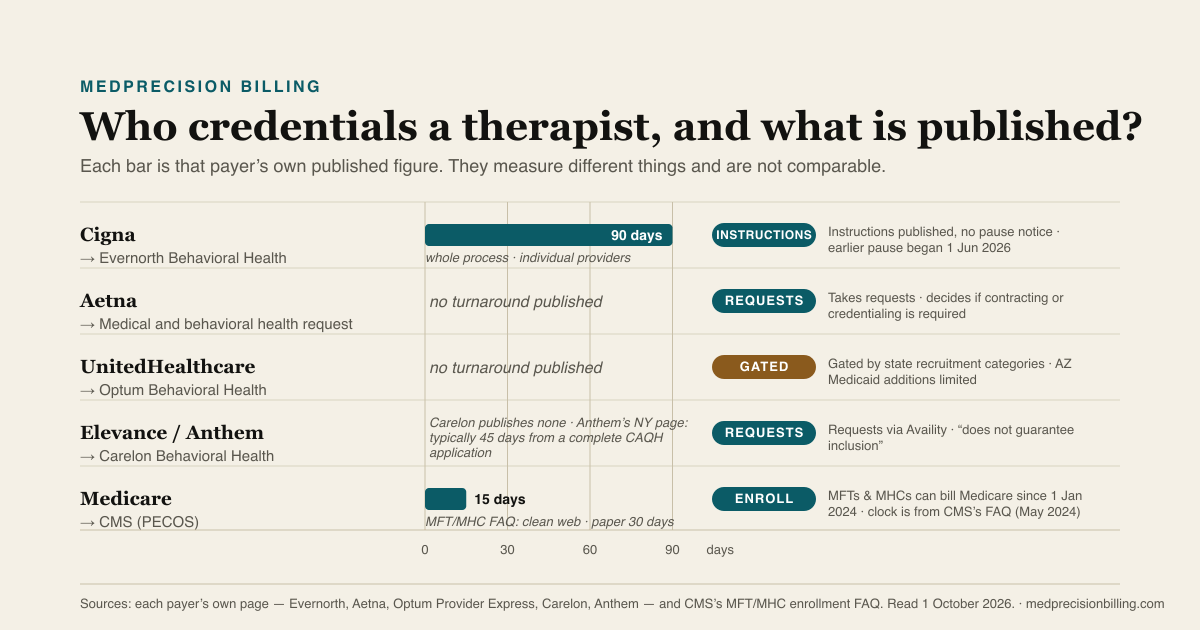
At Cigna, UnitedHealthcare and Elevance, Behavioral Health Has Its Own Credentialing Route
At Cigna and UnitedHealthcare, behavioral health is credentialed by a different organization from the plan's medical network, on a different application, with its own eligibility rules. Elevance Health runs both a Carelon route and an Anthem route. Aetna takes medical and behavioral health professionals in one request, as the table in the next section shows.
For Cigna, its own credentialing page names the behavioral arm: "Effective September 1, 2021, Cigna Behavioral Health, Inc. officially became Evernorth® Behavioral Health, Inc." (read on Cigna's credentialing page on 1 October 2026). The timeframe printed on that same page, "This typically takes 45 to 60 days to complete," is the medical credentialing clock. Cigna publishes no behavioral health timeframe there.
Three words get used interchangeably in this process and should not be.
- Credentialing is the plan verifying who you are: license, degree, supervised hours, malpractice history, sanctions, work history.
- Contracting is the plan agreeing to pay you — a participation agreement, at a rate, signed by both sides.
- A panel is the plan's list of accepted in-network providers for a given network in a given area. "The panel is closed" means the plan has stopped adding providers of that type there.
You can be credentialed and not contracted. You can be neither, and be told the panel is not open, which is a decision about the market and not about your file. Aetna's FAQ says both steps have to finish ("Both processes need to be complete to become an Aetna network provider"), and Carelon says "You must be credentialed and approved before being added to the network." Evernorth also describes case-by-case provisional credentialing: "In certain circumstances, providers may receive provisional credentialing, allowing them to begin seeing patients before the full credentialing process is complete." The published order of the two steps varies by payer. Optum says its credentialing process starts only after a preliminary determination that it wants to contract. Carelon places a signed contract (Step 2) before credentialing (Step 3), except that a clinician joining a group that already has a participation agreement is "added to the existing agreement once you've been approved for credentialing." Aetna's join page says "After contracting, and if Credentialing applies, we'll get your credentialing application" from CAQH and, in its next step, "When you complete credentialing, your contract will be finalized"; its FAQ page says "Once credentialing is complete, you'll get a written notice. Then, your network management contact will help you complete the contracting process." Sources: Aetna's join page and Aetna's FAQ page, read 1 October 2026.
That is what the rest of this page maps: who credentials you, what each payer says about its own timing and panel status, and what it leaves blank. If you would rather not run it yourself, we run your payer credentialing applications, follow-up and renewal calendar.
Who Credentials a Therapist at Each Major Payer, and What Each One Publishes
This page covers five doors: Cigna, Aetna, UnitedHealthcare, Elevance Health (Anthem), and Medicare. Behind three of the four commercial payers sits a behavioral health organization that is not the plan's medical network; the fourth, Aetna, takes behavioral clinicians in a combined request. The table names each one, quotes what that payer publishes about its own timing, and records the panel status on the day the page was read. Evernorth's page changed twice between June and September 2026, so the read date is doing real work here.
| Payer | Who actually credentials a therapist | What that payer publishes as a clock | Panel status, as of 1 October 2026 |
|---|---|---|---|
| Cigna | Evernorth Behavioral Health (HealthPartners for managed care in Minnesota, North Dakota and western Wisconsin; clinicians at a participating Cigna medical practice who take no direct community referrals join under the practice's medical contract). Apply in the Evernorth Provider Portal under My Practice > Contracting; which needs the Contracting entitlement (assigned under My Practice > Manage User Access by your website access manager, who must assign it to themselves if that is you) | "can take up to 90 calendar days to complete (or as otherwise required by law)" — published for individual providers | Application instructions published; no pause notice. The pause began 1 June 2026. Maryland, Ohio and Washington must apply through the Evernorth portal as of 1 September 2026. Texas: the page carries a notice with a window of "from February 1, 2026 through February 28, 2026" and does not say whether it applies to behavioral applicants, so email BehavioralProviderRecruitment@Evernorth.com before you decide to wait |
| Aetna | A "Medical and behavioral health" request for participation on Aetna's join page; Aetna's FAQ page still lists Behavioral health as an application type. Confirm the application type on the joining line before you submit. For joining questions the FAQ gives 1-888-632-3862 (TTY 711) and says the CAQH registration kit comes within 10 business days after you send the application request form | No eligibility or credentialing turnaround published on its join page or FAQ for medical or behavioral applicants. The Internet Archive's 14 July 2026 capture carried a 45-day eligibility sentence ("let you know within 45 days whether you're eligible for participation"); it is absent from the live page, which carries a 28 August 2026 modified date. The only day-count left on the join page, 60 days, sits on the Facility tab | Takes requests for participation; Aetna says it will "evaluate the current need to service our membership in your area and determine if contracting and/or credentialing are required" |
| UnitedHealthcare | Optum Behavioral Health, via the Provider Express site | Not published on the Optum network pages | Gated by the recruitment categories posted on each state network page (the Texas page adds that Optum "accepts applications in compliance with" Texas's Any Willing Provider law); Arizona Medicaid additions limited |
| Elevance Health / Anthem | Carelon Behavioral Health, via Availity. Carelon's join page says individuals, groups and providers joining a group enroll through Availity; a Carelon PDF guide linked from that page (undated) sends behavioral clinicians working in a multi-specialty group to Anthem's own join page (anthem.com). The Anthem join page read here (New York) also lists behavioral health among the provider types invited to "Begin application." The Carelon page and the PDF conflict, so call Carelon's National Provider Services Line, 800-397-1630, before you file | Not published by Carelon; Anthem's own join page, as read on 1 October 2026 (it opens "We are glad you are interested in joining the Anthem network in New York"), says its credentialing "typically takes 45 days from the time the credentialing department receives your completed CAQH application" | Requests are submitted through Availity; Carelon states that submitting "does not guarantee inclusion" |
| Medicare | Your Medicare Administrative Contractor, via PECOS or a paper CMS-855I | Generally 15 calendar days following receipt for a clean web application and 30 for a clean paper one, per CMS's MFT and MHC enrollment FAQ (May 2024), which adds that the timeframes "may be extended if the application is incomplete or missing information or documentation" (the web page itself publishes no clock) | MFTs and MHCs can bill Medicare independently since 1 January 2024; applications opened around 1 November 2023, with no effective date earlier than 1 January 2024 |
Evernorth publishes the only behavioral-arm end-to-end clock for therapists that we found. Up to 90 calendar days describes the whole process of joining the Evernorth network, and on its rebuilt page it appears in the individual-provider block. The figure is not new: the Internet Archive's 9 August 2026 capture of the old page gave "up to 90 days" for individual providers, clinics and facilities alike.
Optum and Carelon leave the clock blank. Neither publishes an end-to-end credentialing turnaround on the Optum network pages or the Carelon join page read here. CMS's MFT and MHC web page publishes none either; the enrollment FAQ it links to supplies the 15- and 30-day general processing times in the table. That is a finding, not a gap in this guide. Where a payer publishes no number, this page prints no number. A guide that prints a day-count for a payer that publishes none is repeating an estimate, not a source.
Cigna's behavioral page changed, and it is the reason this page prints read dates. Evernorth paused new individual and clinic applications on 1 June 2026 and told applicants to revisit after 1 September. It has since replaced that page with a rebuilt join-the-network page carrying instructions for individual providers, clinics and facilities. Two conditions catch people out: the application "must be completed in a single session," and providers in Maryland, Ohio or Washington "must apply through the Evernorth provider portal." The full breakdown lives on our Cigna Provider Credentialing Guide.
Read the date, not the advice
Every payer page cited here is dated in this copy because payer pages change without notice. An undated evergreen guide cannot tell you when anyone last checked it. A dated read can. When you check a panel yourself, write down the URL and the date you looked, the same way this table does, because any row in this table can change without notice. Our Aetna Provider Credentialing Guide applies the same method to Aetna's request-for-participation routes.
Reading Panel Status: What Closed, Limited and Does Not Guarantee Inclusion Actually Mean
Panel notices use specific language, and the difference between the words decides whether applying is worth your afternoon. Here are four payers in their own words, all read on 1 October 2026, with the earlier Evernorth and Aetna wording taken from the Internet Archive.
Evernorth used the word "paused," then replaced the page, which is the whole lesson. In the Internet Archive capture of 9 August 2026 (web.archive.org/web/20260809163043/static.evernorth.com/assets/evernorth/provider/resourceLibrary/behavioralResources/doingBusinessWithUs/cbhCredentialing.html), its behavioral credentialing page said that as of June 1 Evernorth had paused applications from new individual and clinic providers, said other providers could complete its Provider Interest Form or "revisit this webpage after September 1, 2026," and called the pause "temporary," looking forward to "a new and improved application and credentialing experience in September." It named a date to revisit, not a date for anything to change, and gave no guarantee. By 31 August 2026, the last-modified date of the redirect now served at that address, the page had been replaced: the URL redirects to a rebuilt join-the-network page that, read on 1 October 2026, opens "Thank you for your interest in joining the Evernorth® Behavioral Health provider network" and carries full instructions for individual providers, clinics and facilities.
Aetna's join page no longer carries its 45-day eligibility sentence or its separate Behavioral Health tab. In the Internet Archive capture of 14 July 2026 (web.archive.org/web/20260714181714/https://www.aetna.com/health-care-professionals/join-the-aetna-network.html), the page said Aetna would "let you know within 45 days whether you're eligible for participation and begin the contracting process," and a Behavioral Health tab told behavioral health professionals, "including those joining a medical group," to complete a separate Behavioral Health Request for Participation form. Both are absent from the live join page, which carries a 28 August 2026 modified date. It now has one combined tab: "You will need to complete the request for participation form if you're interested in joining Aetna's network and you are a medical health care professional, physician or non-physician, including Behavioral Health professionals." Step 2 says only that Aetna will "evaluate the current need to service our membership in your area and determine if contracting and/or credentialing are required," with no day-count attached. The one surviving number on the page, 60 days, sits on the Facility tab, which does not apply to an individual therapist.
Carelon uses the phrase "does not guarantee inclusion." Its join page states: "Applicants interested in joining Carelon's Network may submit a request to join. Submitting your information and the required documentation does not guarantee inclusion in Carelon's Network(s)." Carelon also states that "All new enrollment requests must be submitted via the Carelon Behavioral Health Payer Space in Availity" and that "You must be credentialed and approved before being added to the network." See Carelon's join-our-network page.
Optum posts the most specific limits of the four. Optum's Provider Express site states that if you do not fall under one of the recruitment categories shown on your state network page, Optum is unable to accommodate your request at this time. It also still posts an Arizona notice, carrying Optum's own date of 4/13/23 as read on 1 October 2026, stating that Optum Behavioral Health is limiting additions to its Arizona Medicaid network to autism, ABA and BCBA providers and autism diagnostic providers in areas of network need, plus providers joining an existing participating group — and that its commercial and Medicare Advantage networks "remain open to all types of behavioral health providers." The notice names one state and one line of business.
Aetna ties its decision to "the current need to service our membership in your area," Optum to the recruitment categories on its state pages, Evernorth called its pause "temporary," and Carelon says only that submitting "does not guarantee inclusion."
When a door is closed, this is the sequence that keeps the work moving:
- Check the payer's own status page, not a third-party summary, and record the URL and the date you read it.
- Get on the interest list wherever the payer publishes one — Evernorth did while its pause lasted, through its Behavioral Health Provider Interest Form, and its rebuilt page no longer lists one.
- Check whether joining an already-contracted group is an accepted route. Optum names group affiliation as its own application path, with its own published eligibility rules. Evernorth treats joining an existing practice as part of its individual-provider path and sends behavioral clinicians at a participating Cigna medical practice who take no direct community referrals to 1 (800) 882-4462. Aetna's join and FAQ pages give no therapist-specific instructions for joining a medical group; its Facility tab says "A separate application needs to be submitted for each physician/provider in your group."
- Work the doors that are open, in the order your actual payer mix demands. If a quarter of your inquiries name one plan, that plan is your first application regardless of which one is easiest.
- Re-check on the date the payer names, not on a guess. Evernorth named 1 September 2026, and the page had already changed by then. Put your own re-check date in a calendar and open the page yourself.
Timing across payers, cost, and the recredentialing cycles that apply to every provider type are covered in our Payer Credentialing Timeline and Cost guide.
Optum's Five Doors, and Which One Fits You
Optum Behavioral Health credentials therapists for UnitedHealthcare, and it does not have one way in. It has five, and its own site states which clinicians each one is for. Each door has its own eligibility line, so confirm which one fits before you file. Optum's statements below come from its Provider Express site, read 1 October 2026.
- Autism, ABA and BCBA. Optum states it is recruiting Board Certified Behavior Analysts in solo private practice and qualified agencies that provide intensive ABA services in the treatment of autism spectrum disorder, for its Autism/ABA provider network. A BCBA does not use the general clinician door.
- Individually credentialed clinician. Optum states that to apply as an individual, you must be a solo clinician or practicing within a group that does not currently have a group agreement with Optum. If your group already has one, the group door applies, but for non-delegated groups Optum says "all providers must be individually credentialed" and links back to the individually credentialed clinician page to begin; delegated groups contact their delegation specialist.
- Group with individually credentialed providers. Optum states that to apply for group with individual credentialing, you must be part of a group that has a group agreement with Optum. This is the door the previous bullet sends you to.
- Group with agency credentialing. Optum states this route is for groups designated as a Community Mental Health Center, Federally Qualified Health Center, Rural Health Center, Opioid Treatment Program, or another federally or state licensed or certified entity — licensed at the organizational level, not the clinician level.
- Facility or hospital-based. Optum states the facility must offer mental health or substance use disorder inpatient, residential, partial hospitalization or intensive outpatient levels of care.
One sentence on Optum's site reframes the entire process. Optum states that the process described in its credentialing plans "will be initiated only after we make a preliminary determination that we want to pursue contracting or re-contracting with the applicant." Read plainly: Optum says the process in its credentialing plans starts only after it decides it wants to contract with you, and its network pages publish no clock for either step; individual clinicians can track their online submission with the Initial Credentialing Status Toolbar.
CAQH is the gate at Optum and, in most states, at Aetna. CAQH is the industry's shared provider-data profile; payers pull your verified information from it instead of asking you to re-key it. Optum states that CAQH participation "is required in the majority of the states to join our network." Aetna states you must designate it as an authorized health plan so it can access your application. Note the name change: DataSpring's own clinician page states "CAQH is now DataSpring," the portal is called the CAQH Provider Data Portal, and payer pages still say ProView.
Optum publishes its own list of what delays a behavioral credentialing file, and CAQH problems head it: a profile whose status is incomplete or expired, and Optum not having authorization to access the CAQH application at all. The mechanics of keeping that profile clean — including the re-attestation cycle — are covered in our CAQH ProView Credentialing Guide.
For individually credentialed clinicians, Optum's intake document is the Network Participation Request Form, or NPRF, reached through Provider Express; facilities and agencies use Optum's separate Facility and Agency applications. For status, Optum directs individually credentialed clinicians to log into the secure area of Provider Express and follow My Practice Info, then My Network Status, then Check Initial Credentialing Status. Agency or group practices and facilities are directed to call Optum's Network Management line at (877) 614-0484; for Autism/ABA applicants the Our Network page gives the same number, while Optum's ABA page says to log in to Provider Express and use Check Initial Credentialing Status under My Network Status.
The Medicare Door That Opened for MFTs and Mental Health Counselors in 2024
Medicare began paying marriage and family therapists and mental health counselors directly in 2024. CMS states: "Effective January 1, 2024, MFTs and MHCs can bill Medicare independently for their services furnished for the diagnosis and treatment of mental illnesses." These are two provider types that could not bill Medicare independently before that date (CMS says they could begin submitting enrollment applications around 1 November 2023, with no effective date earlier than 1 January 2024). The year is 2024, not 2026; guidance written before 2024 is wrong for exactly these two groups.
The authority is Section 4121 of the Consolidated Appropriations Act, 2023. CMS implemented it in the CY 2024 Physician Fee Schedule final rule, stating that it "provides for Medicare Part B coverage and payment under the Medicare Physician Fee Schedule for the services of marriage and family therapists (MFTs) and mental health counselors (MHCs) when billed by these professionals." The same section, CMS states, "allows MFTs and MHCs to furnish services in Rural Health Clinics (RHCs) and Federally Qualified Health Centers (FQHCs)." Source: the CY 2024 Physician Fee Schedule final rule fact sheet.
The number to plan around, in CMS's own words: "Medicare Part B pays MFTs and MHCs for these services at 75% of what a clinical psychologist is paid under the Medicare Physician Fee Schedule." That is stated on the CMS page for these provider types, last modified 07/20/2026 and read 1 October 2026. It is a percentage of another provider type's rate, not a dollar amount, and this page does not turn it into one.
CMS publishes the eligibility criteria directly. An MFT must possess "a master's or doctor's degree which qualifies for licensure or certification as a marriage and family therapist" under the law of the state where services are furnished, must be licensed or certified by that state, and must have "at least 2 years or 3,000 hours of post master's degree clinical supervised experience in marriage and family therapy in an appropriate setting such as a hospital, SNF, private practice, or clinic." The MHC criteria mirror them, and CMS names the license titles it accepts: "licensed or certified as a mental health counselor, clinical professional counselor or professional counselor by the State in which you perform services" — which CMS's FAQ says "is not exhaustive and will vary by state," so a counselor licensed or certified under a different state title can still enroll as an MHC if every applicable statutory and regulatory qualification is met. CMS adds that "addiction counselors and alcohol and drug counselors who meet all the applicable requirements of an MHC may enroll in Medicare as MHCs."
CMS publishes a four-step enrollment path:
- Register in the Identity and Access Management System, the CMS sign-on system that controls who may act for you.
- Get a National Provider Identifier in NPPES, the national provider registry. Your NPI is the number every claim carries.
- Enroll in Medicare through PECOS, the online enrollment system, or on a paper CMS-855 application.
- Work with your Medicare Administrative Contractor, the regional company that processes your enrollment and your claims.
CMS also states: "Your effective enrollment date will be January 1 or later." Its FAQ explains the launch rule behind that sentence: MFTs and MHCs "will not be granted an effective date earlier than January 1, 2024." And the CMS page states that "MFT and MHC services furnished to skilled nursing facility (SNF) residents on or after January 1, 2024 are excluded from consolidated billing" — which means the clinician bills these services separately instead of the SNF including them in its Medicare Part A payment, with the SNF's Medicare provider number on the claim. All of the above is from the CMS page for marriage and family therapists and mental health counselors and the MFT and MHC enrollment FAQ it links to, read 1 October 2026.
CMS's web page publishes no processing time for an MFT or MHC enrollment, but its MFT and MHC enrollment FAQ (May 2024), linked from that page, says clean web applications are generally processed within 15 calendar days following receipt and clean paper applications within 30 calendar days following receipt, and that those timeframes "may be extended if the application is incomplete or missing information or documentation." Do not borrow a timeframe from a contractor's page and attribute it to CMS. The individual enrollment form itself is covered in our CMS-855I enrollment guide, and we run the whole filing as Medicare provider enrollment.
What Changes by License Type: LCSW, LMFT, LPC, LMHC, Psychologist, BCBA
Start with the honest version: at the commercial payers on this page, the organization that credentials you is the same regardless of your license. An LCSW and a licensed psychologist both go to Evernorth for Cigna, both go to Optum for UnitedHealthcare, both go to Carelon for Elevance (the table covers Carelon's group-routing conflict), and both use the "Medical and behavioral health" request for participation on Aetna's join page. The payer pages read here publish no per-license table that sends one license to a different credentialing organization; what Optum's state network pages do list are recruitment categories by prescriber status, degree level, specialty and county.
What genuinely changes by license is narrower, and it is worth knowing exactly:
- Whether the payer accepts your license is a state answer, not a national one. Optum's state forms pages state that you must hold "an independent, unrestricted and valid license from this list" — but the per-state license lists that Optum's state network pages link to returned 404 on 1 October 2026, so confirm your license with Optum Network Management before you apply. So "does UnitedHealthcare credential LPCs" has no national answer. It has fifty.
- Whether you can apply at all depends on posted recruitment categories. Optum states that if you do not fall under one of the recruitment categories shown on your state network page, it cannot accommodate the request at this time, and that the state page is revised as its network need changes. Optum's state network pages define those categories partly by license and degree (for example "MD's DO PA RN with prescriptive authority" in all counties but "PhDs and MA Clinicians" only in listed counties on the California page) and partly by service (telemental health, medication-assisted treatment, Express Access, EAP), so a fully licensed clinician outside them cannot be accommodated, under a rule Optum ties to "business and geographic need."
- BCBAs use a different door. At Optum, board certified behavior analysts delivering ABA apply through the Autism/ABA network, not the individually credentialed clinician route. Same payer, different door, different eligibility language.
- MFTs and mental health counselors are new to Medicare. CMS states that effective 1 January 2024 MFTs and MHCs can bill Medicare independently. Any Medicare guidance written before that date is wrong for those two license groups, whatever it says about the others — so check the current CMS page for your own license rather than an undated summary.
- Group size can be its own gate. Optum's California group-contract route describes "a group practice with five (5) or more providers that share the same Tax ID and have a centralized intake and billing department." A four-clinician group and a six-clinician group are not the same applicant to that payer: Optum's group-contract criteria list a "Minimum of 5 providers who will be credentialed," while Evernorth defines a clinic as "groups of four or more independently licensed behavioral health providers who share the same tax identification number (TIN), location, and administrative staff."
One boundary worth drawing. What a license lets you join is a different question from what it lets you bill. Scope of practice, supervision rules, which psychotherapy codes you may report, and telehealth place-of-service handling are all downstream of credentialing and are set by state law and payer policy separately. Those sit with our mental health billing coverage, not here.
The practical takeaway is unglamorous: your license determines whether you clear a state list and which door you use. It does not change who credentials you. Spend the effort on confirming your license with the payer and the open recruitment category, not on hunting for license-specific shortcuts that the payers do not publish.
What These Payers Publish, and What They Leave Blank
Stating the blanks is as useful as stating the facts, because the blanks are where invented numbers come from. Read on 1 October 2026, across the payer pages cited on this page:
Evernorth is the only behavioral arm we found that publishes a therapist-facing, end-to-end credentialing clock. Its rebuilt page states "up to 90 calendar days" for individual providers; the old page, in the Internet Archive capture of 9 August 2026, gave the same figure for individual providers, clinics and facilities. Aetna's join and FAQ pages publish no turnaround for a therapist; the 60 days on its join page's Facility tab does not apply to one. Optum publishes no credentialing turnaround in days on any of its network pages. Carelon publishes none across the numbered steps of its join page. CMS's MFT and MHC web page publishes none, but the enrollment FAQ it links to (May 2024) says clean web applications are generally processed within 15 calendar days following receipt and clean paper applications within 30, and that the timeframes may be extended if the application is incomplete or missing information or documentation.
None publishes a national open-or-closed panel map. Optum publishes per-state network pages and one standing Arizona Medicaid limitation. Evernorth's archived page carried a pause notice, and its rebuilt page does not. Aetna and Carelon publish conditions rather than status. None of these payers publishes a list you can check in one place, which is why panel status has to be checked payer by payer, on the payer's own page, with the date written down.
None publishes approval rates or the share of applications declined. No payer here states how many applications it accepts, how long a place on an interest list lasts, or what share of files are declined for network need versus for credentialing findings.
Several recredentialing cycles are published. Optum's 2026-2027 Credentialing Plan (read 2 October 2026) says it reviews participating clinicians "every 36 months or more frequently if required by applicable state law"; Anthem's join page (the version read opens "We are glad you are interested in joining the Anthem network in New York") says it "recredentials network providers every three years"; and CMS's enrollment FAQ says "In general, providers and suppliers revalidate every five years" for Medicare enrollment. Carelon states: "To remain in the network, you must follow a re-credentialing approval process every three years or the period required by state laws or regulations." Carelon and Optum each publish a correction window: Carelon's is seven calendar days (a discrepancy with third-party information must be corrected in writing, with corrections sent directly to its credentialing staff), and Optum's Credentialing Plan gives applicants ten business days from its written notice to submit corrections. Carelon's provider handbook says that once a provider has been approved for credentialing and contracted, Carelon "will advise of the effective date for specified lines of business." See Carelon's provider handbook, read 1 October 2026.
That leaves one honest operating rule, and it is the same rule this page followed to write itself: open the payer's own page, quote what it actually says, write down the date you read it, and go back on the date the payer names. Evernorth named 1 September 2026. We went back after that date and found the old page retired and replaced by a rebuilt page that shows no pause notice, rewrote this guide on 17 September 2026 with the sibling Cigna guide, and re-read every cited payer page again on 1 October 2026. That is the rule working, not failing: a payer page that was true in August was out of date by September, and the only thing that caught it was a written-down date and a return visit.
Free Billing Audit · No obligation
Let Our Credentialing Team Handle the Applications
Application intake, CAQH profile and attestation management, payer follow-up, and the status checks that keep a file from being closed for silence. We run payer credentialing and provider enrollment: the applications, the follow-up and the renewal calendar across your payer roster, so your providers' applications do not stall on missing information.
Prefer to talk? Book a 15-minute callRequest received
A billing specialist will review your practice details and reach out within 1 business day. No confirmation email is sent — if you need to reach us sooner, call +1-872-297-2815.
Common Questions
Common questions about insurance credentialing for therapists: who credentials you at each payer.
Get a Free Billing Audit
Our billing specialists can walk you through this and more.
Get a Free Billing AuditWho credentials therapists for insurance panels?
Three of the four commercial payers on this page route therapists to a behavioral health arm rather than the medical network, with exceptions each payer publishes. Cigna routes to Evernorth Behavioral Health, UnitedHealthcare to Optum Behavioral Health via Provider Express, and Elevance Health to Carelon Behavioral Health via Availity; Aetna's join page names behavioral health professionals in a single "Medical and behavioral health" request for participation. Medicare is the exception: you enroll through PECOS or a paper CMS-855I application, and your Medicare Administrative Contractor processes it. Verified on each payer's own page as of 1 October 2026.
Is Evernorth taking therapist applications right now?
Evernorth's rebuilt join-the-network page publishes application instructions for individual providers, clinics and facilities and, as of 1 October 2026, shows no pause notice; it makes no statement about whether applications are currently open. Individual providers apply in the Evernorth Provider Portal, which needs the Contracting entitlement, and the page states the process "can take up to 90 calendar days to complete (or as otherwise required by law)." Two conditions catch people out: the application "must be completed in a single session," and providers in Maryland, Ohio or Washington must apply through the portal. Texas carries a notice with a February 2026 window that does not say whether it applies to behavioral applicants; email BehavioralProviderRecruitment@Evernorth.com before you decide to wait. In Minnesota, North Dakota and western Wisconsin, Evernorth contracts for EAP services only and HealthPartners handles managed care. Evernorth paused new individual and clinic applications on 1 June 2026 and this page changed twice between June and September, so confirm before you plan.
How long does therapist credentialing take?
Evernorth is the only behavioral arm on this page we found that publishes an end-to-end timeframe for individual providers: "up to 90 calendar days" for the whole process, stated on its rebuilt page under the individual provider path. For Medicare, CMS's MFT and MHC enrollment FAQ (May 2024) says clean web applications are generally processed within 15 calendar days following receipt and clean paper applications within 30 calendar days following receipt, and that the timeframes may be extended if the application is incomplete or missing information or documentation. Aetna's join and FAQ pages, Optum and Carelon publish no turnaround for a therapist on the pages read 1 October 2026, and CMS publishes none on its MFT and MHC web page. A number quoted for therapist credentialing is a payer statement only if it names the payer and the page it came from; otherwise it is an estimate.
Do I need CAQH to credential as a therapist?
In most cases yes. Optum states CAQH participation "is required in the majority of the states to join our network." Aetna's join page says that after contracting, and if credentialing applies, it gets your credentialing application from CAQH, and asks you to designate Aetna as an authorized health plan; its FAQ page describes credentialing as finishing before contracting. Carelon asks you to add it as an authorized organization and keep your attestation current. CAQH requires re-attestation every 120 days — 180 for Illinois providers — and its glossary defines an Expired Attestation as one "greater than 120 days old," per the CAQH provider user guide (version 43, last updated 22 August 2023); Evernorth's page, read 1 October 2026, repeats the 120- and 180-day cycle. See our CAQH ProView Credentialing Guide.
Can an LMFT or mental health counselor bill Medicare?
Yes. CMS states: "Effective January 1, 2024, MFTs and MHCs can bill Medicare independently for their services furnished for the diagnosis and treatment of mental illnesses." CMS also states that "Medicare Part B pays MFTs and MHCs for these services at 75% of what a clinical psychologist is paid under the Medicare Physician Fee Schedule." You must hold a master's or doctor's degree that qualifies for state licensure or certification, be state licensed or certified, and have completed at least 2 years or 3,000 hours of post master's degree clinical supervised experience. Source: CMS, read 1 October 2026.
What do I do if a panel is closed to new therapists?
Five steps. Check the payer's own status page and record the URL and the date. Join the interest list where the payer publishes one; Evernorth did while its pause lasted, and its rebuilt page no longer lists one. Check whether joining an already-contracted group is an accepted route — Optum names group affiliation as a separate application path with its own eligibility rules. Work the doors that are open, in the order your payer mix demands. Then re-check on the date the payer names, not on a guess.
How do I check the status of my credentialing application?
It depends on the door you used. Optum directs individually credentialed clinicians to log into the secure area of Provider Express and follow My Practice Info, then My Network Status, then Check Initial Credentialing Status; agency or group practices and facilities call Optum's Network Management line at (877) 614-0484, and Autism/ABA applicants either call the same number (Our Network page) or log in to Provider Express and use Check Initial Credentialing Status (ABA page). Aetna's FAQ says providers outside Missouri call 1-800-353-1232 (medical and behavioral health) for a credentialing status update, and Missouri providers use a form. Carelon takes all new enrollment requests through the Carelon Behavioral Health Payer Space in Availity, so status lives there. Verified 1 October 2026.
What happens if a payer declines my application?
Usually you get written notice. Optum's Credentialing Plan (2026-2027 edition, read 2 October 2026) says that if it "declines to include individual or groups of providers in the provider network, written notice is given to the affected providers including the reason for decision," and that "State laws determine appeal rights for initial credentialing denials." Carelon's handbook says that, unless the notice says otherwise, providers have 30 calendar days from the date of notice of an adverse credentialing decision to file a written appeal. Aetna states on its facility tab: "If the panel is not open or we do not intend to pursue a contract, you will be notified by a letter or email, that the request has been denied." Neither Optum's plan nor Carelon's handbook says whether those appeal rights cover a network-need decision, so the practical next move is a dated re-check and, where the payer publishes one, an interest list.
Related Services
Related Specialties
Related Guides
- Cigna Provider Credentialing: How to Join the Network
- Aetna Provider Credentialing: What Aetna Actually Publishes
- CAQH ProView Is Now the CAQH Provider Data Portal (2026 Guide)
- Payer Credentialing Timeline and Cost (2026)
- CMS-855I: What the Form Itself Requires, Section by Section
- Provider Enrollment Checklist (2026): 32 Items and When Each Applies
Let Our Credentialing Team Handle the Applications
Application intake, CAQH profile and attestation management, payer follow-up, and the status checks that keep a file from being closed for silence. We run payer credentialing and provider enrollment: the applications, the follow-up and the renewal calendar across your payer roster, so your providers' applications do not stall on missing information.
- No contract
- No setup fees
- Reply within 1 business day