CMS-855B: The Medicare Enrollment Application for Clinics, Group Practices, and Other Suppliers
By MedPrecision Editorial Team · Published
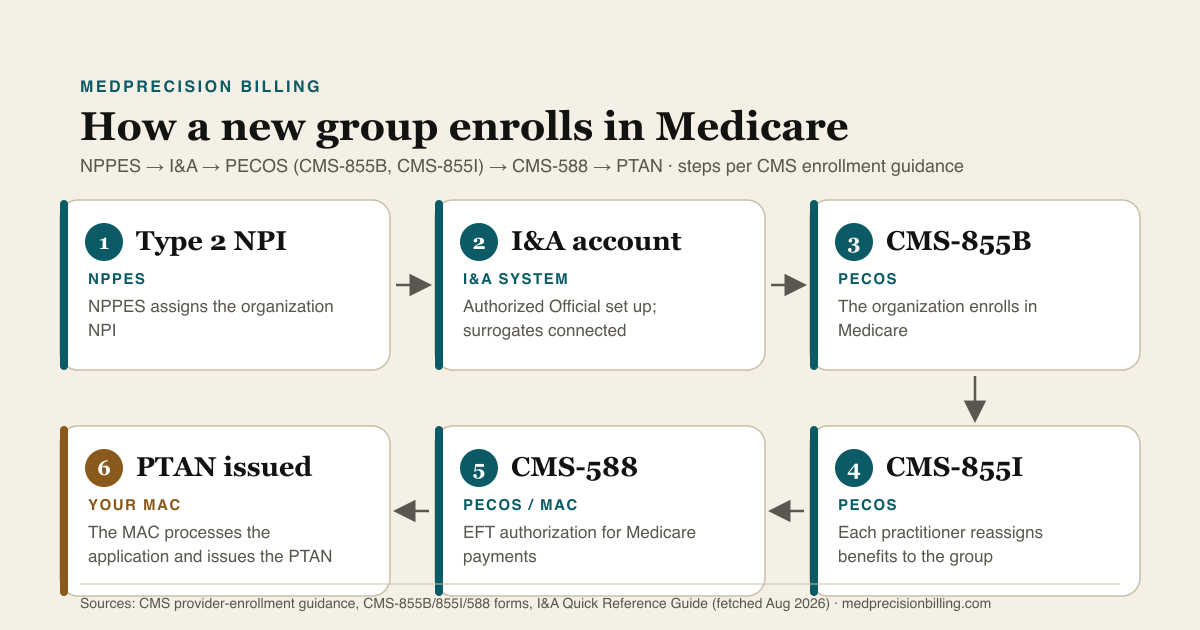
CMS-855B enrolls the organization, not the people inside it. A clinic or group practice files it to get the entity its own Medicare billing number; the physicians who work there enroll separately and then reassign their benefits to the group. Everything on this page is about provider enrollment — an organization becoming authorized to bill the Medicare program — not about a beneficiary signing up for Medicare coverage. If you searched "855B" while helping a patient with their Medicare card, this is the wrong page. What follows is built from the current form and CMS's own pages, quoted verbatim and date-stamped, because the 855B is a form where paraphrase gets people rejected: the legal business name has a matching rule with three systems in it, the $750 application fee applies to some 855B filers and explicitly not to others, and the reassignment mechanics changed in 2023 in a way many guides still miss. If you would rather hand the whole sequence — NPI, I&A, PECOS, 855B, 855I, EFT — to a team that handles them, our Medicare provider enrollment service runs it end to end while your Authorized Official keeps control of the credentials. Either way, the sections below are the map, verified against CMS sources on 11 August 2026.
What is the CMS-855B form used for?
CMS-855B is the Medicare enrollment application for clinics, group practices, and certain other suppliers. An organization enrolls in Medicare through PECOS using CMS-855B, or files the paper form with its MAC. Applicants require a Type 2 NPI, and physician and non-physician practitioner group practices are exempt from the $750 application fee.
What the CMS-855B Is and Who Files It
The official title, per CMS's forms catalog, is "Medicare Enrollment Application - Clinics/Group Practices and Certain Other Suppliers," OMB number 0938-1377, current revision dated 29 April 2026. Always pull the form from that catalog page rather than a saved copy — the form's own instructions warn, "Be sure you are using the most current version."
The form itself answers the who-files question in one sentence: "Clinics, group practices, and other suppliers must complete this application to enroll in the Medicare program and receive a Medicare billing number." It then gives the working definition of its audience: "A medical practice, group/clinic or other supplier that will bill for Medicare Part B services (e.g., group practices, clinics, independent laboratories, portable x-ray suppliers)." Section 2B of the form lists the supplier types you check — Clinic/Group Practice, Ambulatory Surgical Center, Independent Clinical Laboratory, Independent Diagnostic Testing Facility, Opioid Treatment Program, Pharmacy, Ambulance Service Supplier, Portable X-ray Supplier, and others — with an instruction most multi-line organizations miss: "If you are more than one type of supplier, submit a separate application for each type."
Two prerequisites sit on the form's first pages. First: "NOTE: Applicants using this application require a Type 2 NPI." NPPES assigns the NPI, and the assignment is a separate process that must finish before the 855B is filed — our Type 2 NPI guide covers the organizational NPI in detail. Second, the form is explicit that new enrollment is only one of its jobs. You also file an 855B when you are, in the form's own scenario list: enrolling "for the first time with this Medicare Administrative Contractor (MAC) under this tax identification number"; enrolled but operating under "a new tax identification number" (which requires a complete new application, not a change); opening a location in "another Medicare Administrative Contractor's (MAC's) jurisdiction"; revalidating (a provider revalidates enrollment only when told to — the form says, "Do not submit a revalidation application until you have been contacted by your MAC"); reactivating a billing number; reporting changes; accepting, terminating, or changing a reassignment of Medicare benefits; reporting a CHOW as a certified Part B supplier; or voluntarily terminating billing privileges.
One scenario surprises hospital teams: a "hospital, hospital department, or other medical practice or clinic that may bill for Medicare Part A services but will also bill for Medicare Part B practitioner services" files an 855B for that Part B billing — the 855A it already holds does not cover it. Section 2C of the form exists specifically for hospitals listing departments that need separate Part B billing numbers.
CMS-855B vs CMS-855I vs CMS-855A: One Decision Table
The three main 855-series enrollment applications split by what kind of entity is enrolling and what it bills. Every row below quotes the respective form's own "who should submit" language, verified 11 August 2026.
| Form | Who files it, in the form's own words | Typical filers |
|---|---|---|
| CMS-855I | "All physicians, as well as all eligible professionals as defined in section 1848(k)(3)(B) of the Social Security Act must complete this application to enroll in the Medicare program and receive a Medicare billing number." Also serves "an individual practitioner or eligible professional who has formed a professional corporation, professional association, limited liability company, etc., of which you are the sole owner." | Physicians, NPs, PAs, other individual practitioners — including a solo doctor who incorporated |
| CMS-855B | "Clinics, group practices, and other suppliers must complete this application to enroll in the Medicare program and receive a Medicare billing number." Requires a Type 2 NPI. | Group practices, clinics, independent labs, ASCs, IDTFs, ambulance suppliers |
| CMS-855A | "Institutional providers must complete this application to enroll in the Medicare program and receive a Medicare billing number," and it lists the organizations that must use it — including Hospital, Skilled Nursing Facility, Home Health Agency, Hospice, Federally Qualified Health Center, Rural Health Clinic, Critical Access Hospital, End-Stage Renal Disease Facility, and Community Mental Health Center. | Part A institutional providers |
| CMS-855R | Discontinued. The current 855I states: "NOTE: All reassignment actions should now be reported via the CMS-855I. The CMS-855R (Reassignment of Medicare Benefits) form has been discontinued." | Nobody — see our CMS-855R guide for the post-2023 workflow |
The edge cases are where filings go wrong:
- A sole-owner professional corporation or PLLC does not file the 855B. The 855I's own scope covers the practitioner who is "the sole owner" of the entity. Filing an 855B for a one-physician PC adds an application the MAC did not need.
- A hospital can hold both. As quoted in the previous section, a hospital billing Part B practitioner services files an 855B on top of its 855A.
- Opioid Treatment Programs get a choice. The 855A states: "Opioid Treatment Programs may complete the CMS-855A or CMS-855B enrollment application."
- The group's 855B does not enroll its physicians. A practitioner enrolls in Medicare using CMS-855I, then reassigns benefits to the group. A new group that files only the 855B has an enrolled shell with nobody who can generate billable claims — the sequencing is covered in the final section below.
PECOS vs Paper: Submission Routes and What MACs Publish About Timing
The form lists two routes: "Clinics, group practices, and other suppliers can apply for enrollment in the Medicare program or make a change in their enrollment information using either: The Internet-based Provider Enrollment, Chain and Ownership System (PECOS), or The paper CMS-855B enrollment application." In practice, an organization enrolls in Medicare through PECOS using CMS-855B — the online interview collects the same data the paper form does. CMS's PECOS enrollment page makes the agency's preference plain: "Because PECOS is paperless, you no longer need to submit anything by mail. Additionally, PECOS applications tend to process faster than paper applications." Our PECOS enrollment guide walks the portal itself.
"Faster" has published numbers behind it, and they are worth quoting precisely because they are timeliness standards, not promises. Novitas Solutions' processing-timeframes page (a MAC page; we verified it 11 August 2026 — it carries a query-string URL, so search "Novitas application processing timeframes" to reach it) publishes what it calls CMS-defined timeframes: for "Internet-based PECOS applications" covering initial enrollment that "Do not require a site visit, development and/or fingerprinting: 95% completed within 15 calendar days of receipt, 100% completed within 50 calendar days of receipt." For paper: "Require a site visit, development and/or fingerprinting: 95% completed within 65 calendar days of receipt, 100% completed within 100 calendar days of receipt. Do not require a site visit, development and/or fingerprinting: 95% completed within 30 calendar days of receipt, 100% completed within 65 calendar days of receipt." National Government Services (operating as Wellpoint Federal since April 2026) states a simpler goal, with no percentile bands, on its enrollment hot-topics page (reviewed by NGS 2 September 2025): "All MACs, including National Governments Services, have a goal to finalize an Internet-based PECOS application within 15 days and a CMS-855 paper application within 30 days, if all required information is available." Read the qualifiers: "goal," "if all required information is available," percentile bands. No MAC guarantees a date, and neither should anyone filing on your behalf.
| Route | Site visit / development / fingerprinting | Novitas' published CMS-defined timeframe |
|---|---|---|
| PECOS | Not required | 95% within 15 calendar days; 100% within 50 |
| Paper CMS-855B | Not required | 95% within 30 calendar days; 100% within 65 |
| Paper CMS-855B | Required | 95% within 65 calendar days; 100% within 100 |
If you do file on paper, two mechanical rules from the form: "This form must be typed. It may not be handwritten," and the completed application "with original signatures and all required documentation" goes to your designated MAC — the contractor for your state, not to CMS.
Completing the 855B for a New Group: The Sections That Decide Approval
The paper form runs long, but its own Section 1 chart tells you which sections each filing scenario requires — a new enrollee completes "all applicable sections," while narrower actions like a practice-location change need as few as five. What follows is where new-group applications actually fail, keyed to the form's structure and quoted from the current revision.
Section 2: the legal-business-name test
The first field of Section 2A1 is labeled "Legal Business Name as Reported to the Internal Revenue Service," paired with the TIN. The form's tips section makes the matching rule explicit: "Ensure that the legal business name shown in section 2 matches the name on the tax documents." And the NPI note raises the stakes to three systems: "The Legal Business Name (LBN) and Tax Identification Number (TIN) that you furnish in section 2A must be the same LBN and TIN you used to obtain your NPI. Once this information is entered into PECOS from this application, your LBN, TIN and NPI must match exactly in both PECOS and NPPES." A name mismatch is a self-inflicted delay: the practice's IRS record says "ABC Medical Group, P.C." and the NPPES record says "ABC Medical Group" — and the mismatch surfaces as a development request weeks later. Reconcile the IRS name (the CP-575 EIN confirmation letter is the cleanest reference for what the IRS actually has), the NPPES record, and the application before anything is submitted. Two more Section 2 rules: the correspondence address "cannot be a billing agent or agency's address or a medical management company address," and if you skip the IRS-designation checkbox, "the supplier will be defaulted to 'Proprietary.'"
Section 3: adverse legal actions, fully reported
Section 3 captures convictions, exclusions, license revocations and suspensions, and the form forecloses the judgment calls people want to make: "All applicable final adverse legal actions must be reported, regardless of whether any records were expunged or any appeals are pending." Under-reporting here is not a paperwork problem; it goes to the certification your official signs in Section 15.
Section 4: practice locations, including telehealth
Every location where the group renders services to Medicare beneficiaries gets its own copy of Section 4A — "including any distant site(s) where you render telehealth services." The address rules are strict: "All reported practice location addresses must be a specific street address as recorded by the United States Postal Service. ... Your practice location address cannot be a Post Office (P.O.) Box." The current revision's location-type checkboxes include "Home Office for Administrative/Telehealth Use Only" and "Business Office for Administrative/Telehealth Use Only" — the checkboxes virtual-first groups need, and a detail older walkthroughs of this form predate. Note the jurisdiction boundary: "Only report those practice locations that are within the jurisdiction of the designated MAC to which you will be submitting this application"; locations under another MAC mean a separate 855B to that MAC. For a new enrollment, the date reported for a location "should be the date you saw your first Medicare patient at this location" — which interacts with the effective-date and retrospective-billing rules covered below.
Sections 5, 6, and 8: owners, managing employees, billing agency
The form's own change-of-information chart maps "Ownership Interest and/or Managing Control Information (Organizations)" to Section 5, the same for individuals to Section 6, and "Billing Agency Information" to Section 8. For a new group these disclosure sections are where thoroughness pays: every owner and managing employee the form requires, disclosed the first time, is a development request you never receive.
Section 15: the Authorized Official signs
The Authorized Official signs — the form's tips close with "Sign and date section 15," and its chart distinguishes signature blocks 15A1 (Authorized Official) from 15B1 (delegated official). Match this against the EFT agreement in your packet: the CMS-588's own instructions require it to be "signed and dated by the same Authorized Representative or a Delegated Official named on the CMS-855 Medicare enrollment application which the Medicare contractor has on file." A CMS-588 signed by the office manager while the 855B is signed by the physician-owner is a silent mismatch that stalls the payment side of the enrollment.
The Application Fee: Who Pays $750 and Who Is Exempt
The Medicare enrollment application fee is one of the most commonly misbudgeted line items in this process, so here is the whole rule from CMS's own pages, verified 11 August 2026.
The amount: CMS's Medicare Provider Enrollment MLN page states, "We updated the enrollment application fee amount for 2026. ... The 2026 enrollment application fee is $750." The fee is recalculated annually, so date-stamp any figure you carry into a budget.
The exemption, from the same CMS page: "Physicians, non-physician practitioners (NPPs), physician organizations, non-physician organizations, and Medicare Diabetes Prevention Program (MDPP) suppliers don't pay a Medicare enrollment application fee. Generally, institutional providers and suppliers like DMEPOS suppliers and opioid treatment programs pay an application fee when enrolling, re-enrolling, revalidating, or adding a new practice location."
Read those two sentences together and the confusion dissolves: the fee attaches to what kind of organization is enrolling, not to which form it files. A physician or NPP group practice filing the CMS-855B is a "physician organization" — it pays nothing, at initial enrollment and at revalidation. Meanwhile some other 855B supplier types are on the paying side; CMS's examples are DMEPOS suppliers and opioid treatment programs, and CMS publishes a fee-applicability matrix for the rest — if your organization is not a physician or NPP group, confirm your row there rather than assume.
| Enrolling via CMS-855B | Application fee? | Source |
|---|---|---|
| Physician group practice / physician organization | No — exempt | CMS MLN provider-enrollment page |
| Non-physician practitioner group / non-physician organization | No — exempt | CMS MLN provider-enrollment page |
| Opioid treatment program | Generally yes — $750 for CY2026 | CMS MLN provider-enrollment page |
| Other non-exempt supplier types | Check CMS's fee-applicability guidance for your type | CMS application-fee matrix (not quoted here) |
For filers that do owe it, timing is specified on the form itself: "The supplier pays the required application fee (via PECOS.cms.hhs.gov/pecos/feePaymentWelcome.do) upon initial enrollment, the addition of a new business location, and revalidation PRIOR to completing and submitting this application to the MAC." Pay first, file second.
One caution from the other direction: any vendor quote that folds "$750 CMS fee" into the price of enrolling a physician group is charging you for a fee CMS says the group does not owe.
Documents to Stage Before You File
The form points to its own checklist — the cover instructions say, "Go to section 12 for a list of supporting documentation to be submitted with this application" — and scatters conditional attachments through the sections. Staging these before the filing session is the difference between one submission and a development-request cycle. From the current form, verified 11 August 2026:
- IRS name/TIN evidence. Not listed as an attachment, but Section 2's matching rule ("matches the name on the tax documents") makes the CP-575 or other IRS-issued confirmation the reference document for the entire application. Reconcile it against NPPES before you start, not after the MAC asks.
- EFT authorization with banking evidence. The tips section: "Include the Electronic Funds Transfer (EFT) Authorization Agreement (when applicable) with your enrollment application with a voided check or bank letter." CMS-588 authorizes electronic funds transfer — it does not enroll anybody by itself — and its signer must match the 855's official, as covered above. Our CMS-588 EFT guide covers the form field by field.
- IRS Form 501(c)(3) if you check Non-Profit in Section 2 ("Submit IRS Form 501(c)(3)"; government-owned entities are excused), and IRS Form 8832 "if applicable" for a disregarded entity.
- CLIA and FDA certificates per location. Section 4A: "Attach a copy of the most current CLIA certifications for each practice location(s) reported on this application," and the same instruction for FDA mammography certifications where issued.
- Exclusive-use space agreement for PT/OT groups. Section 2D requires physical/occupational therapy groups answering yes on office-space questions to "attach a copy of any written agreement that gives the group exclusive use of the office space."
- Sales agreement for a CHOW. The Section 1 chart requires change-of-ownership filers to "provide a copy of the sales agreement."
- Adverse-action documentation. Section 3's note: the section must be completed in its entirety "and all applicable attachments must be included."
And one instruction that costs nothing now and saves a records fight later: "Keep a copy of your completed Medicare enrollment package for your own records." Pair this list with our provider enrollment checklist, which covers the identifiers and logins that sit upstream of the documents.
After You Submit: Processing, Development Requests, PTAN, Effective Date
Once the application is in, the MAC processes the application and issues the PTAN — but three things happen in between that are worth knowing in advance.
Development requests have a deadline on your side. The form warns: "The MAC may request additional documentation to support and validate information reported on this application. You are responsible for providing this documentation within 30 days of the request per 42 C.F.R. section 424.525(a)(1) and (2)." A development request is routine — it is the MAC's mechanism for anything unclear or missing — but the 30-day response window is the applicant's to miss, and a missed window puts the application at risk of rejection under that same regulation. Whoever monitors the correspondence address (which, per Section 2, must be the supplier's own, not a billing agency's) needs to treat MAC mail as same-week work.
Approval arrives as a letter carrying the PTAN. CMS's MLN claims-course glossary describes the mechanics: "When a MAC approves enrollment and issues an approval letter, the letter will include the PTAN assigned to the health care professional or supplier." The 855B itself defines the number: "The Provider Transaction Access Number (PTAN), often referred to as a Medicare Supplier Number or Medicare Billing Number, is a generic term for any number other than the National Provider Identifier (NPI) that is used by a supplier to bill the Medicare program." What a PTAN is, how it relates to the NPI, and what to do when nobody wrote the letter down — that is our PTAN guide.
The effective date reaches backward up to 30 days. Federal regulation, not MAC discretion: 42 CFR 424.521 permits the listed provider types to "retrospectively bill for services when the provider or supplier has met all program requirements (including State licensure requirements), and services were provided at the enrolled practice location for up to — (i) Thirty days prior to their effective date if circumstances precluded enrollment in advance of providing services to Medicare beneficiaries; or (ii) Ninety days prior to their effective date if a Presidentially-declared disaster" precluded it. The regulation's eligibility list explicitly includes "Physician organizations" — meaning a group practice that saw Medicare patients in the gap between opening and approval can, within those limits, bill for them. Thirty days is the ceiling, not a cushion; a group that starts seeing Medicare patients months before enrolling has unbillable visits no retro rule recovers.
On overall duration: hold your expectations to the published MAC timeframes quoted earlier — 15-day PECOS goals, percentile standards out to 100 days for developed paper applications — and treat every figure as a standard the MAC works toward, never a commitment.
How the 855B Connects to Reassignments
A newly enrolled group with no reassignments is a billing number with nothing to bill. The group's revenue arrives when a practitioner reassigns benefits to the group — defined on the CMS forms as "Authorization by an individual practitioner to allow an eligible organization/group to submit claims and receive payment for Medicare Part B services that the practitioner has provided as a member of the organization/group."
Since 2023 there is no separate reassignment form. The current CMS-855I states: "All reassignment actions should now be reported via the CMS-855I. The CMS-855R (Reassignment of Medicare Benefits) form has been discontinued." The full post-consolidation workflow — including what happens if someone submits the old form — is in our CMS-855R discontinuation guide.
The sequencing rule that governs a new group launch is printed on the 855I: "Both the individual practitioner and the eligible organization/group must be currently enrolled (or concurrently enrolling via submission of the CMS-855B for the eligible organization/group and the CMS-855I for the individual practitioner) in the Medicare program before the reassignment can take effect." That parenthetical is the practical takeaway: you do not have to wait for the group's 855B to be approved before starting the physician's side. The group's 855B and the physician's 855I — with the reassignment reported in it — can run concurrently, and for a new practice they should, because the enrollment is only revenue-complete when both approvals and the reassignment line up.
The 855B has its own reassignment surface for later changes: the form's change chart maps "Reassignment of Benefits Information" to Section 4H, and its instructions set the signatures — "When establishing a new reassignment, Section 15E must be signed by the individual practitioner and Section 15B or 15D must be signed by a delegated/authorized official of the organization/group." Terminating one is lighter: either the organization's official or the practitioner signs, alone.
The practitioner's half of this — who files the 855I, its section map, and how the reassignment is reported inside it — is the next page in this series: the CMS-855I enrollment guide.
Free Billing Audit · No obligation
Need help filing the 855B?
We run the whole sequence — Type 2 NPI, I&A setup, the group's CMS-855B through PECOS, each physician's 855I and reassignment, and the CMS-588 with the matching signer — on flat-fee packages that include MAC development-request response and submission tracking. Your Authorized Official signs and keeps the credentials; we work through an approved I&A surrogate connection. Tell us your entity type and state and we will map the filing before anything is submitted.
Prefer to talk? Book a 15-minute callRequest received
A billing specialist will review your practice details and reach out within 1 business day. No confirmation email is sent — if you need to reach us sooner, call +1-872-297-2815.
Common Questions
Common questions about cms-855b: how an organization enrolls in medicare.
Get a Free Billing Audit
Our billing specialists can walk you through this and more.
Get a Free Billing AuditWhat is the CMS-855B used for?
CMS-855B is the Medicare enrollment application for organizations: its form states, "Clinics, group practices, and other suppliers must complete this application to enroll in the Medicare program and receive a Medicare billing number." It also handles later actions — revalidation, reactivation, new MAC jurisdictions, reassignment changes, ownership changes, and voluntary termination. It enrolls the entity only; each practitioner enrolls separately on the CMS-855I.
What is the difference between the CMS-855B and the CMS-855A?
The 855A is for institutional providers billing Medicare Part A — its form lists hospitals, skilled nursing facilities, home health agencies, hospices, FQHCs, rural health clinics, and similar organizations. The 855B is for clinics, group practices, and other suppliers billing Part B. Some overlap exists: a hospital billing Part B practitioner services files an 855B in addition to its 855A, and opioid treatment programs may use either form.
Can I file the CMS-855B in PECOS?
Yes. The form lists both routes — internet-based PECOS or the paper CMS-855B — and CMS states that "PECOS applications tend to process faster than paper applications." Novitas' published CMS-defined timeframes show why: PECOS initial enrollments without a site visit or development are 95% completed within 15 calendar days of receipt, versus 30-100 day standards for paper. These are timeliness standards MACs work toward, not guaranteed turnarounds.
Does a group practice pay the Medicare application fee?
A physician or non-physician practitioner group practice does not. CMS's provider-enrollment MLN page states that "Physicians, non-physician practitioners (NPPs), physician organizations, non-physician organizations, and Medicare Diabetes Prevention Program (MDPP) suppliers don't pay a Medicare enrollment application fee." The CY2026 fee of $750 applies to non-exempt organizations — CMS's examples are DMEPOS suppliers and opioid treatment programs — payable through PECOS before the application is submitted.
How do I submit the paper CMS-855B, and where does it go?
The form must be typed — its instructions state, "This form must be typed. It may not be handwritten" — signed and dated by the Authorized Official in Section 15, and mailed with all supporting documentation to your designated MAC, the Medicare Administrative Contractor for your state. It does not go to CMS. The form directs filers to CMS's provider-enrollment pages to locate the correct MAC address.
Does the CMS-855B require an NPI first?
Yes — a Type 2 organizational NPI, which NPPES assigns before Medicare enrollment begins. The form states, "Applicants using this application require a Type 2 NPI," and CMS's NPI booklet is blunt about the consequence: "An enrolment application without an NPI will be rejected." The legal business name and TIN on the 855B must be the same ones used to obtain the NPI, matching exactly across PECOS and NPPES.
What happens after the 855B is submitted?
The MAC processes the application, may issue development requests — the form gives you 30 days to respond under 42 CFR 424.525 — and, on approval, issues the PTAN in the approval letter. Under 42 CFR 424.521, physician organizations can then retrospectively bill up to 30 days before the effective date (90 days in a Presidentially-declared disaster) if all program requirements were met when the services were furnished.
Related Reading on This Topic
Related Services
Related Guides
- CMS-855I: What the Form Itself Requires, Section by Section
- CMS-855R Discontinued: How Medicare Reassignment Works Now
- Medicare PTAN: What It Is, Who Issues It, and How to Find Yours
- CMS-588 EFT Authorization: The Signer Rule and Everything Else
- PECOS Enrollment: Step-by-Step Guide for Providers (2026)
- Provider Enrollment Checklist (2026): 32 Items and When Each Applies
Need help filing the 855B?
We run the whole sequence — Type 2 NPI, I&A setup, the group's CMS-855B through PECOS, each physician's 855I and reassignment, and the CMS-588 with the matching signer — on flat-fee packages that include MAC development-request response and submission tracking. Your Authorized Official signs and keeps the credentials; we work through an approved I&A surrogate connection. Tell us your entity type and state and we will map the filing before anything is submitted.
- No contract
- No setup fees
- Reply within 1 business day